When someone dies at home in the Netherlands, you may first sit with them a while; no law says you must call within a set time. Then call the family doctor (huisarts) or, outside office hours, the out-of-hours GP service (huisartsenpost). If the death may not be natural, call 112 and move nothing.
The funeral itself can wait; the care and cooling of your loved one cannot.
Good to know. RouwUitvaart.nl is not a notary, lawyer or legal adviser. We compile this information with great care, but you cannot derive any rights from it. Always check how things stand for your own situation, or ask a notary or lawyer.
What you can do until the doctor arrives
You do not have to do anything, but a few small things of two minutes make a real difference later.
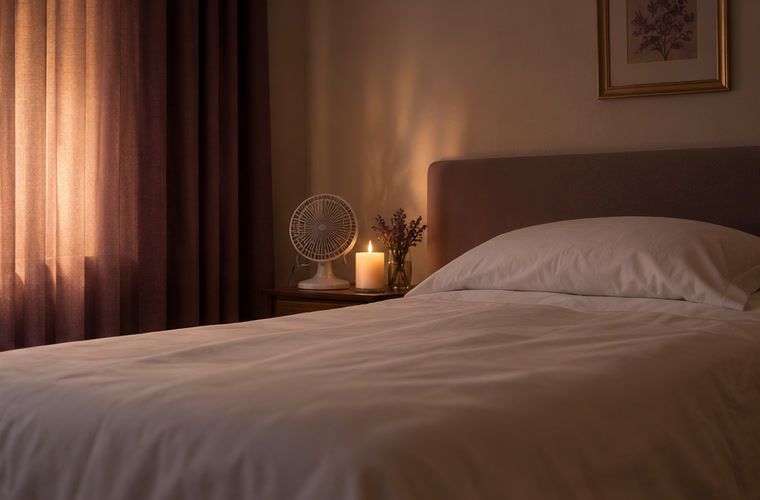
- Keep it cool. Turn the heating off, close the curtains in warm weather and open a window when it is cold. From practice: keep the room as cool as possible, at most around 18 °C. This matters most.
- Close the eyes gently with your fingers. Straight after the death this usually works; later it does not.
- Hands on the stomach, head slightly raised on a pillow. Blood follows gravity; hands lying beside the body discolour.
- No thick blanket. Under a blanket the body stays warm. A thin sheet is fine.
- The mouth can stay as it is. Open or closed does not matter, so do not tie it shut. Do put the dentures ready.
- Washing and moving wait until after the doctor's examination. If there is any doubt about the cause, touch nothing at all.
The first hours after a death at home
The first hours follow six steps in order of time; only step 3 is an exception route, for when there is doubt about the cause of death.
No law requires you to call within a set number of minutes. Stay with your loved one as long as you need; just do not wait for hours, because the cooling cannot wait indefinitely.
Call the family doctor (huisarts) or, outside office hours, at weekends and on public holidays, the out-of-hours GP service (huisartsenpost). Under article 3 of the Burial and Cremation Act (Wet op de lijkbezorging), the examination of the body (lijkschouw) takes place as soon as possible.
Does anything point to an accident, violence or suicide, or is the cause unclear? Move nothing, touch nothing and call 112. After a calm, expected death this does not apply.
If the doctor is convinced of a natural death, the doctor fills in the declaration of death (verklaring van overlijden, the A-form) and a separate cause-of-death statement for Statistics Netherlands (CBS, the B-form). Without the declaration of death, or a statement of no objection from the public prosecutor, the civil registrar of the municipality issues no permit for burial or cremation (article 12, Burial and Cremation Act).
This is the step that cannot wait. The funeral director (uitvaartverzorger) cares for your loved one and arranges the cooling, at home or in a funeral centre. What kind of funeral it will be, you decide later.
With the A-form the death is registered with the municipality (gemeente) where it took place. The municipality draws up the death certificate (akte van overlijden) and issues the permit for burial or cremation. In practice the funeral director arranges this for you.
More about the last step: registering a death in the Netherlands.
What can wait, and what cannot
Almost everything after a death can wait, except the doctor's examination, the last care and the cooling.
- Which funeral director you choose in the end
- Burial or cremation
- The date, the place and the form of the farewell
- What it may cost, and what you do yourself
- The examination by the doctor
- The last care of your loved one
- The cooling: a cooling plate, a cooling unit or a mortuary
As soon as someone has died, the body starts to change, faster in warm weather or a warm room. Without timely cooling, saying goodbye calmly in the days that follow becomes harder. A funeral director can arrange the care and the cooling without you deciding anything about the funeral itself yet; ask beforehand what the care and cooling cost.
When the doctor is not convinced of a natural death
The examination of the body (lijkschouw) is not a post-mortem: the doctor confirms the death and assesses whether it was a natural death.
The doctor only issues a declaration of death when convinced of a natural death (article 7, Burial and Cremation Act). If not, the doctor calls in the municipal forensic doctor (gemeentelijk lijkschouwer); what follows is in the questions below. When a minor has died, the treating doctor only issues the declaration after consulting the municipal forensic doctor (article 10a).
After euthanasia at home the treating doctor does not issue a declaration of death but informs the municipal forensic doctor (article 7, Burial and Cremation Act), who then comes to examine the body. You can ask your doctor beforehand how this will go.
Keeping your loved one at home
Laying out at home (thuisopbaring) is allowed until the funeral, and after a death at home it is often the obvious choice.
The Burial and Cremation Act sets no requirements for the type of home, so an apartment is fine too. The legal terms for the funeral are explained in how soon a funeral takes place.
A funeral director places professional cooling, usually a cooling plate under your loved one, sometimes a cooling unit. Home or a funeral centre: neither is better, and you may change your mind.
What does it cost? Arranging a cremation entirely yourself starts from around €800. Complete laying out at home, with care and cooling, costs up to around €1,200 as a separate service. Fixed funeral options start from around €2,000 for a cremation and around €3,900 for a burial. All prices: funeral costs in the Netherlands, or in Dutch: wat kost een uitvaart.
Was there a funeral insurance policy?
When you have the calm for it, find out whether your loved one had funeral insurance.
The policy conditions determine whether you can choose another funeral director and what the insurer then pays. How the types of policy work is explained on the page about funeral insurance below.
Questions about a death at home
First the family doctor (huisarts) or, outside office hours, the out-of-hours GP service (huisartsenpost). The doctor comes to examine the body and confirm the death. If anything points to an accident, violence or suicide, or the cause is unclear, call 112 and move nothing. After the examination you call a funeral director for the care and cooling.
The doctor confirms the death and assesses whether it was natural. This examination (lijkschouw) is not a post-mortem. If the doctor is convinced of a natural death, the doctor fills in the declaration of death (the A-form) and a separate cause-of-death statement for Statistics Netherlands (CBS, the B-form). If in doubt, the doctor calls in the municipal forensic doctor.
The steps stay the same, but outside office hours, at weekends and on public holidays you call the out-of-hours GP service (huisartsenpost). According to KNMG and Public Prosecution Service guidance, the examination should reasonably take place within three hours of the doctor being informed; the night exception covers only an expected death in a nursing or care home.
Until the funeral: the Burial and Cremation Act sets no maximum for staying at home. Under article 16 the funeral takes place no earlier than 36 hours and no later than the sixth working day after the death. The mayor can, after hearing a doctor, set another term; within 36 hours only in agreement with the public prosecutor (article 17).
Turn the heating off or down, close the curtains in warm weather and open a window when it is cold. From practice: keep the room as cool as possible, at most around 18 °C. Do not use a thick blanket; a thin sheet is fine. The professional cooling, usually a cooling plate, cools only your loved one, not the room.
You still call the family doctor or the out-of-hours GP service, and 112 if there is doubt about the cause. If the doctor is not convinced of a natural death, the doctor calls in the municipal forensic doctor (gemeentelijk lijkschouwer). This is standard procedure, not suspicion. Release can then take longer; the public prosecutor decides.
Usually once the doctor has examined your loved one; you may call earlier. It is not a legal obligation, but in practice the care and cooling cannot wait. A funeral director (uitvaartverzorger) arranges the care, the cooling, the transport and the registration with the municipality. What kind of farewell it becomes, you decide later.
After a calm, expected death you may hold and touch your loved one, close the eyes and place the hands on the stomach. In practice, the deceased is only moved or washed after the doctor has carried out the examination. If there is any doubt about the cause, touch nothing.
Further reading
Lees dit in het Nederlands: Overlijden thuis: wat moet u nu doen?
The pages below are in Dutch: right-click and translate, or call +31 85 004 8099.
More in English
These pages explain the same subjects in English. All other pages on this site are in Dutch.